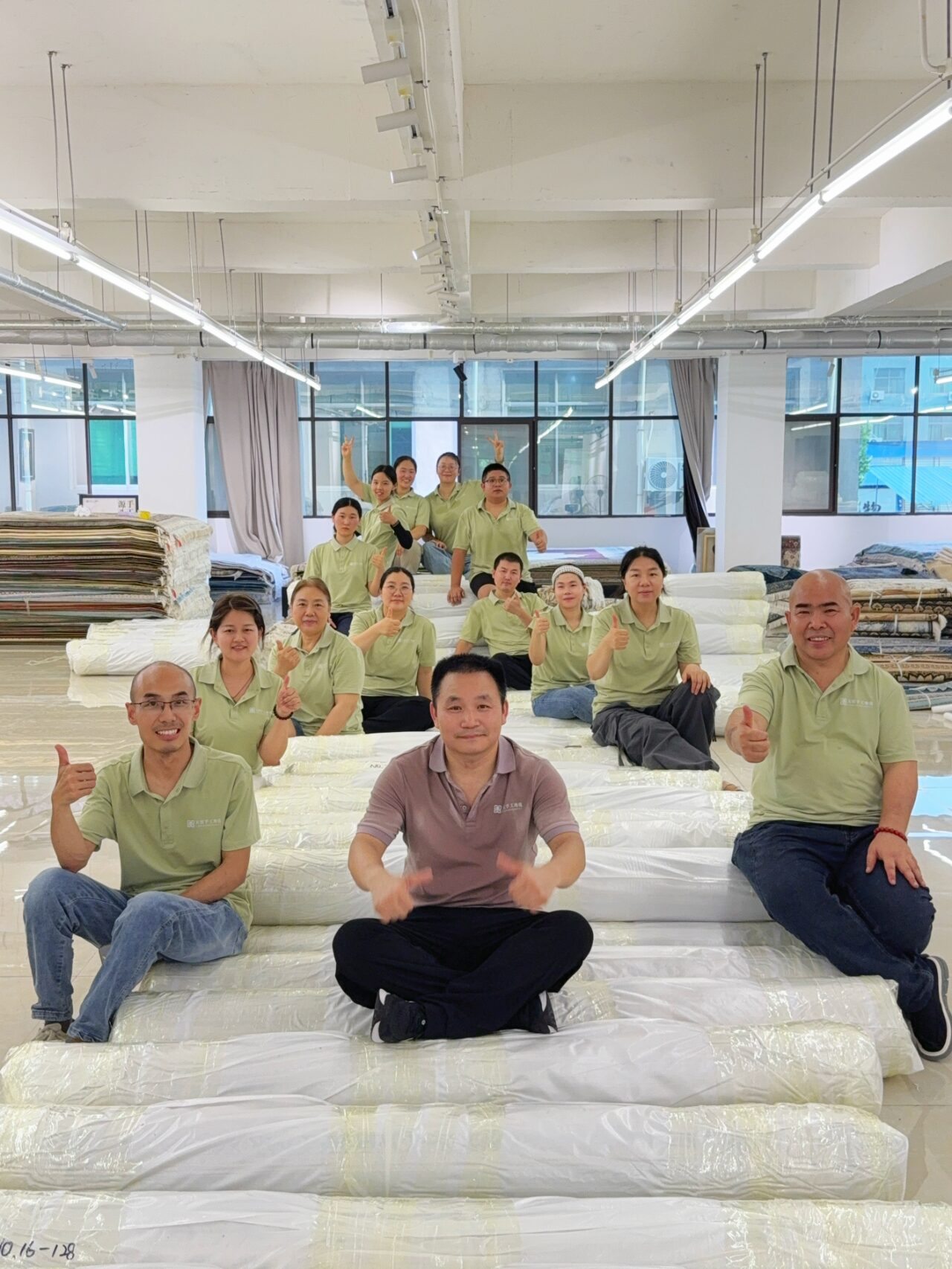
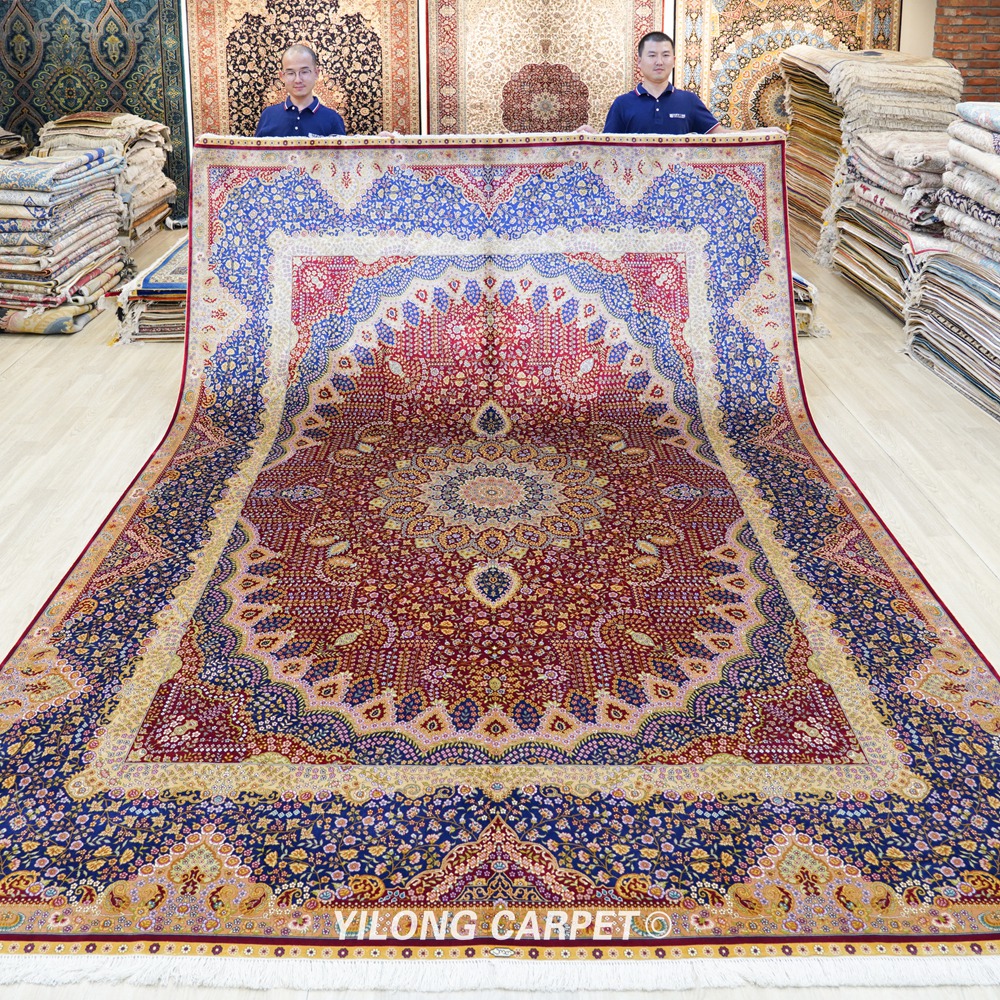
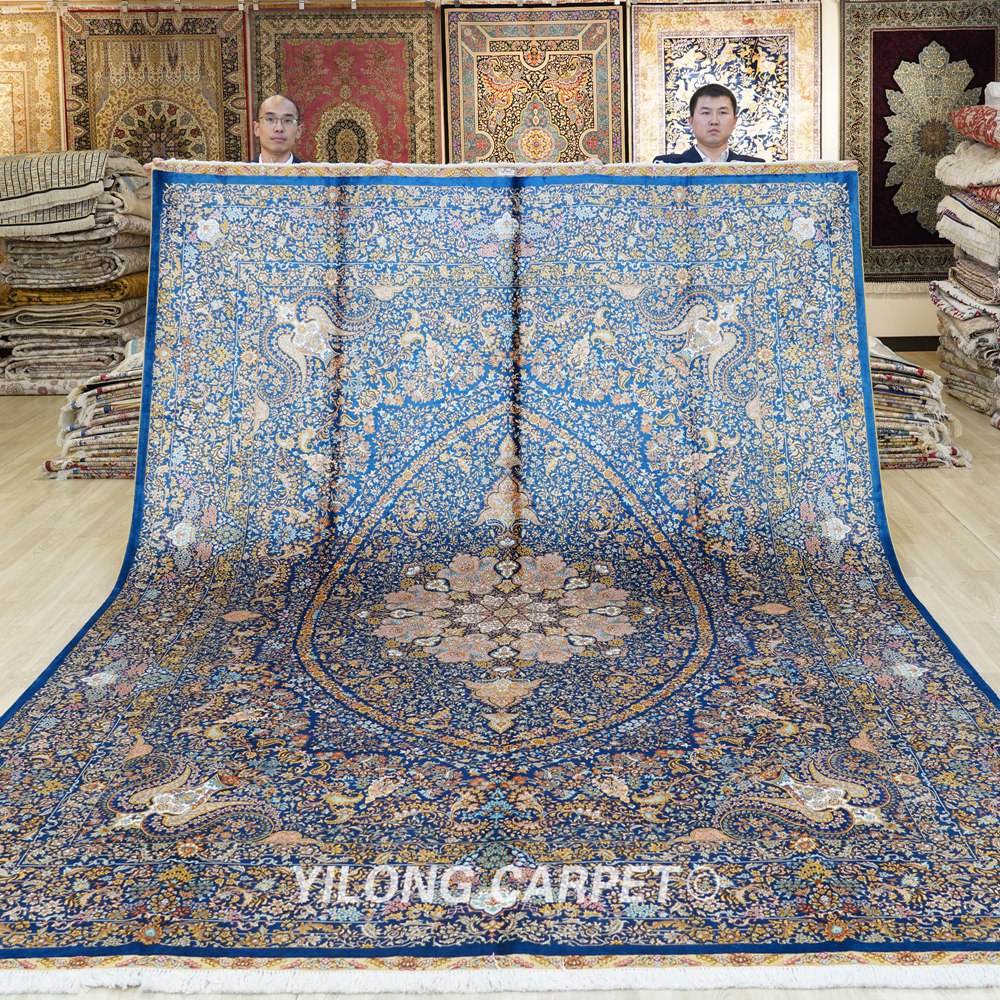
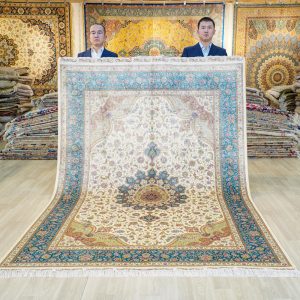
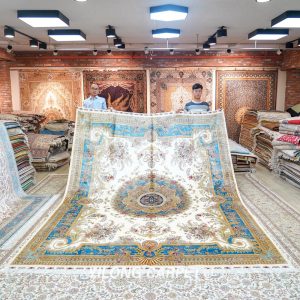
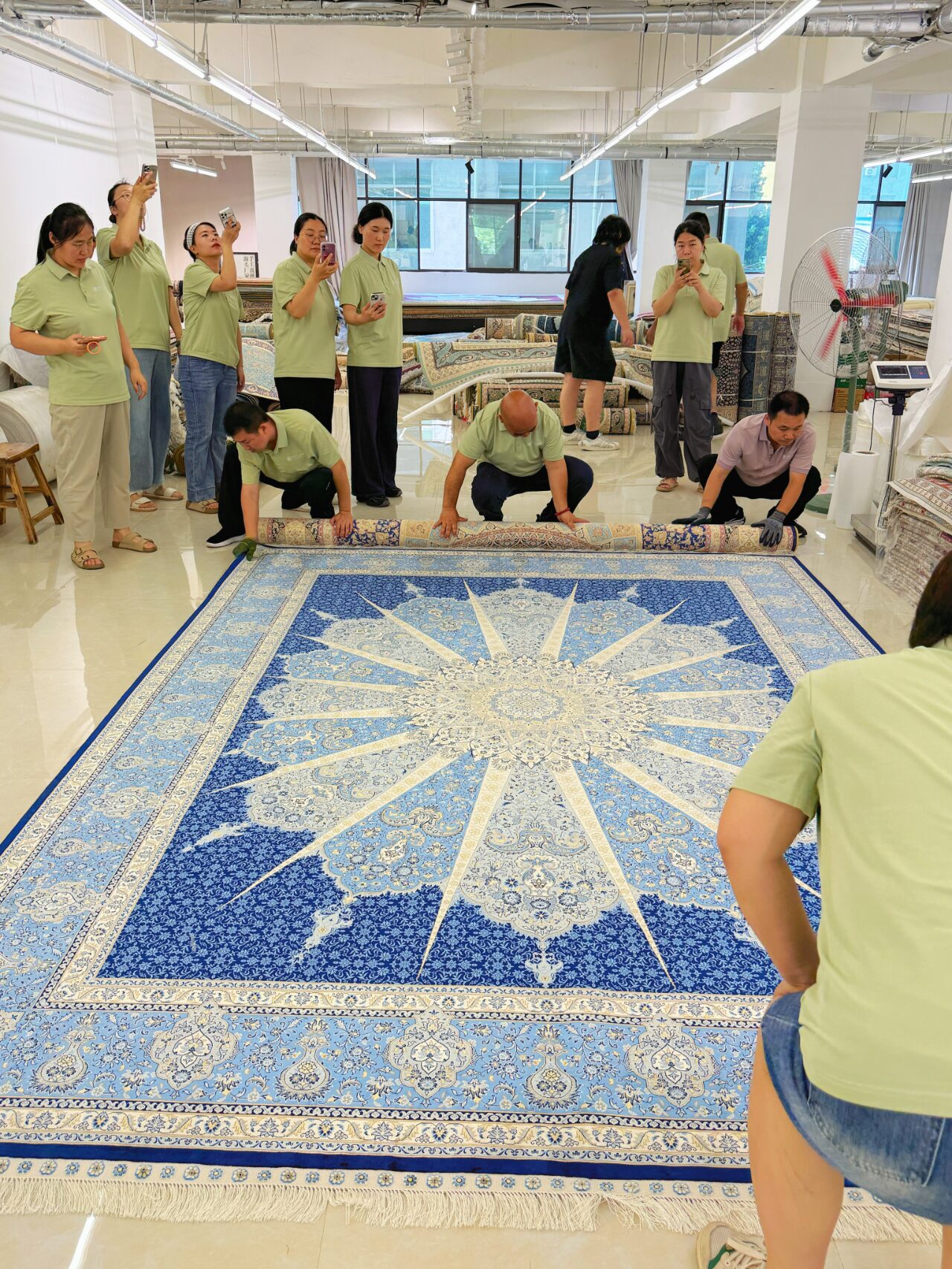
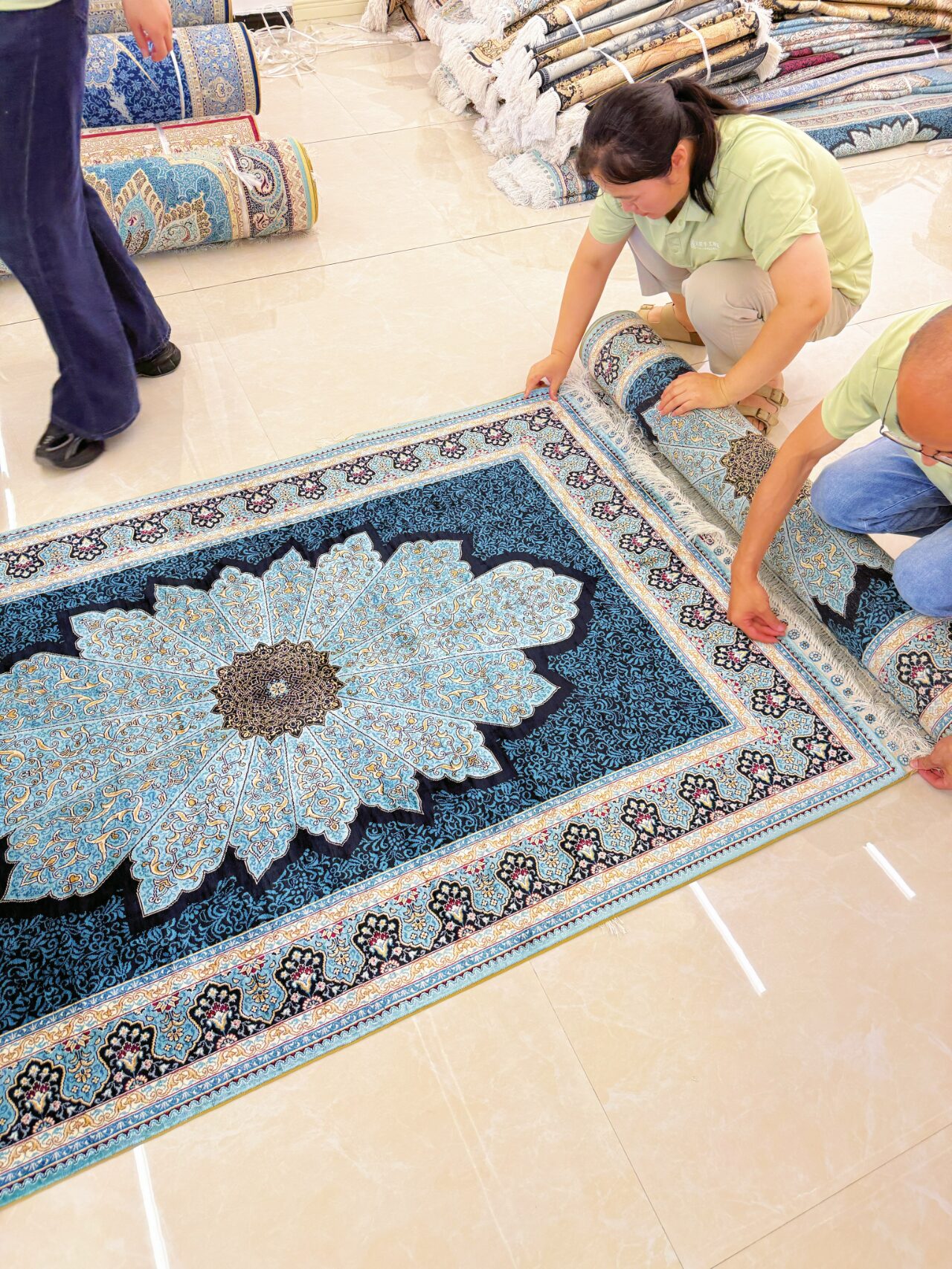
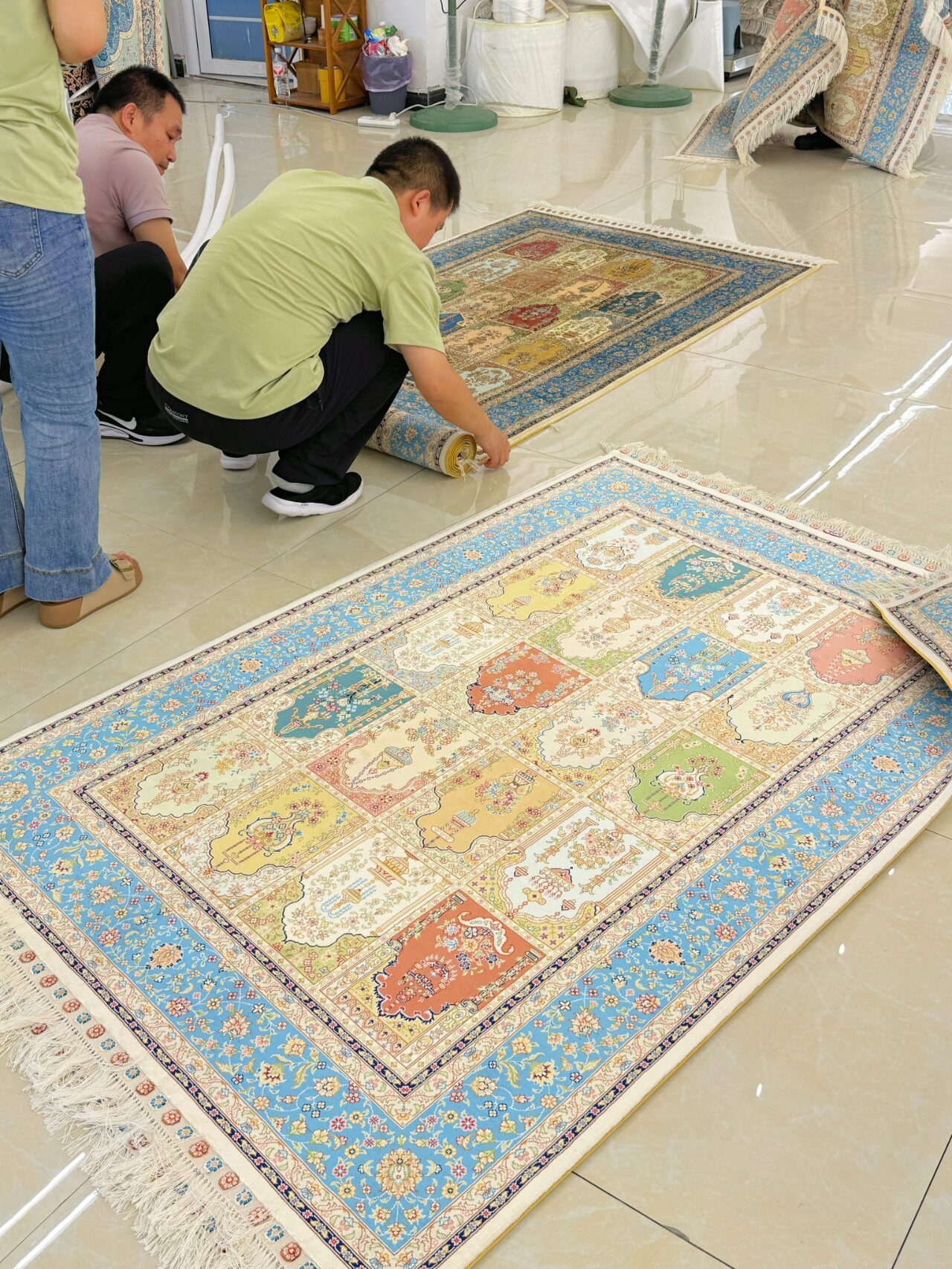
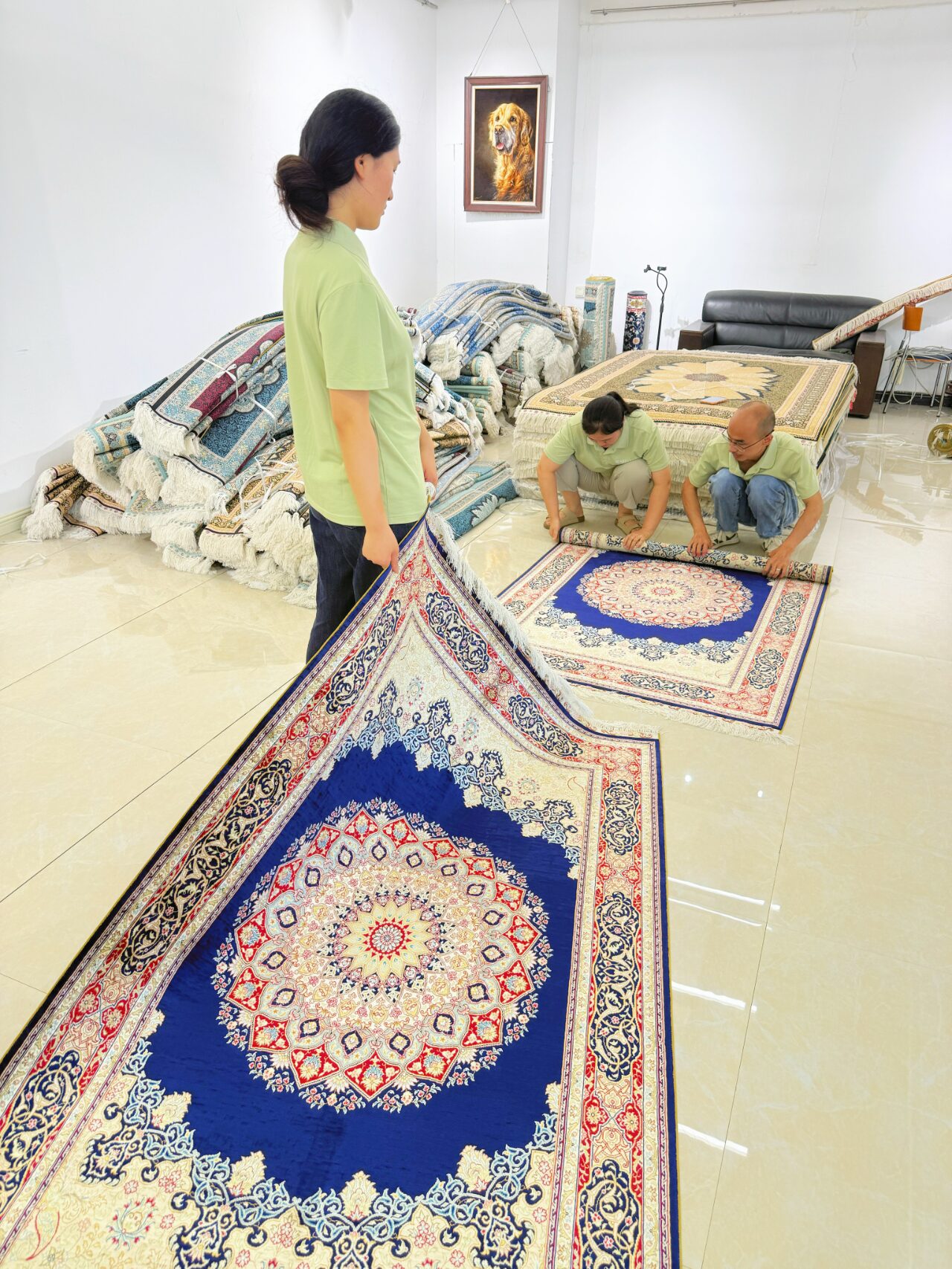
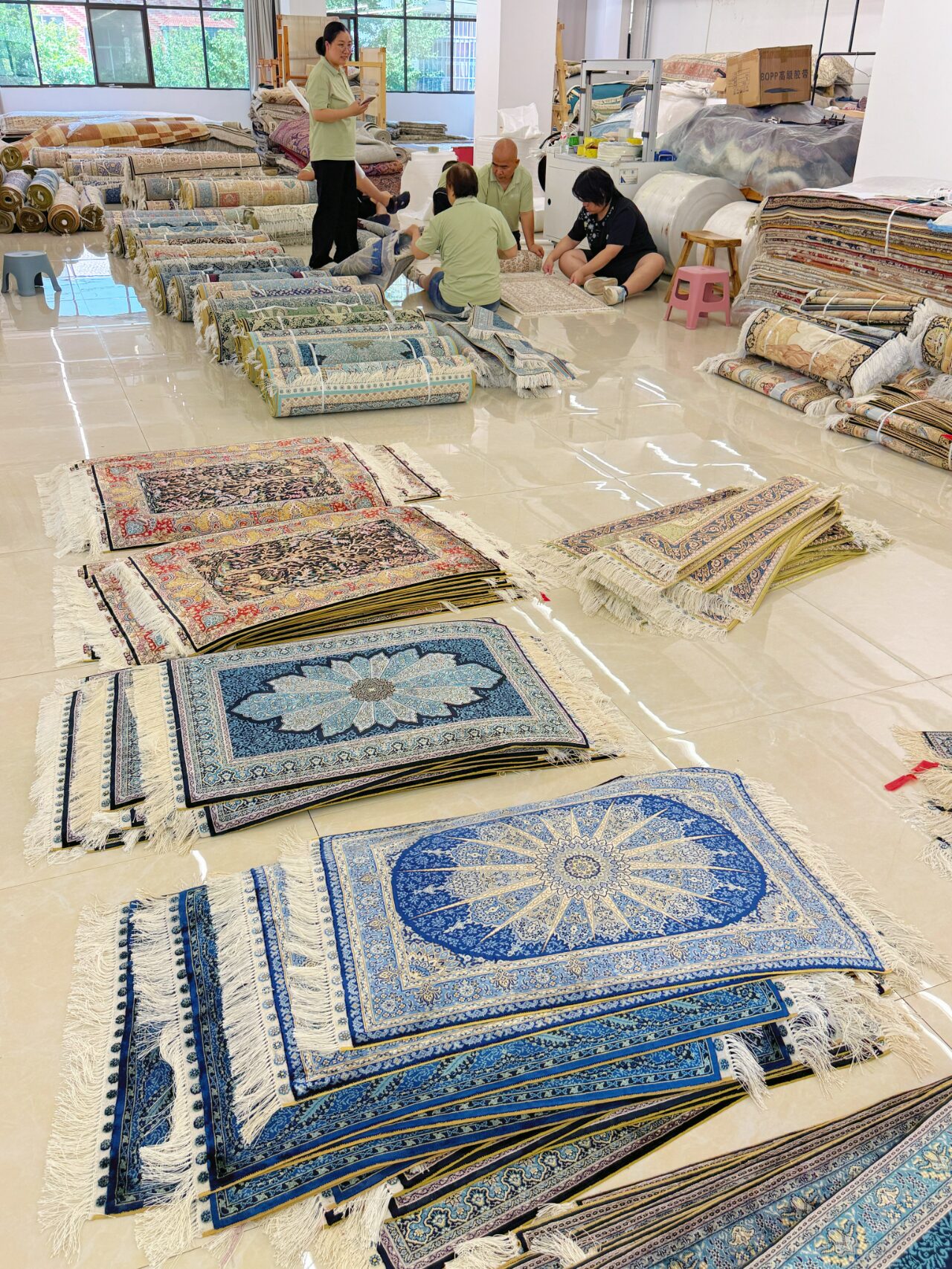
Over the past few days, another batch of about 20,000 sq ft of hand-knotted silk rugs from TJ Carpet has been getting ready to ship to Turkey.
If you only look at the warehouse, it may seem like just another shipment. The rugs are unfolded, checked, sorted, rolled, packed, and then prepared for loading.
But when we look a little further, this is not just a shipping number.
Behind these 20,000 sq ft of silk rugs is months of handwork by nearly one thousand weavers. These rugs are moving from the loom to the overseas market. What they travel through is not only physical distance, but also a changing path in the international carpet trade.
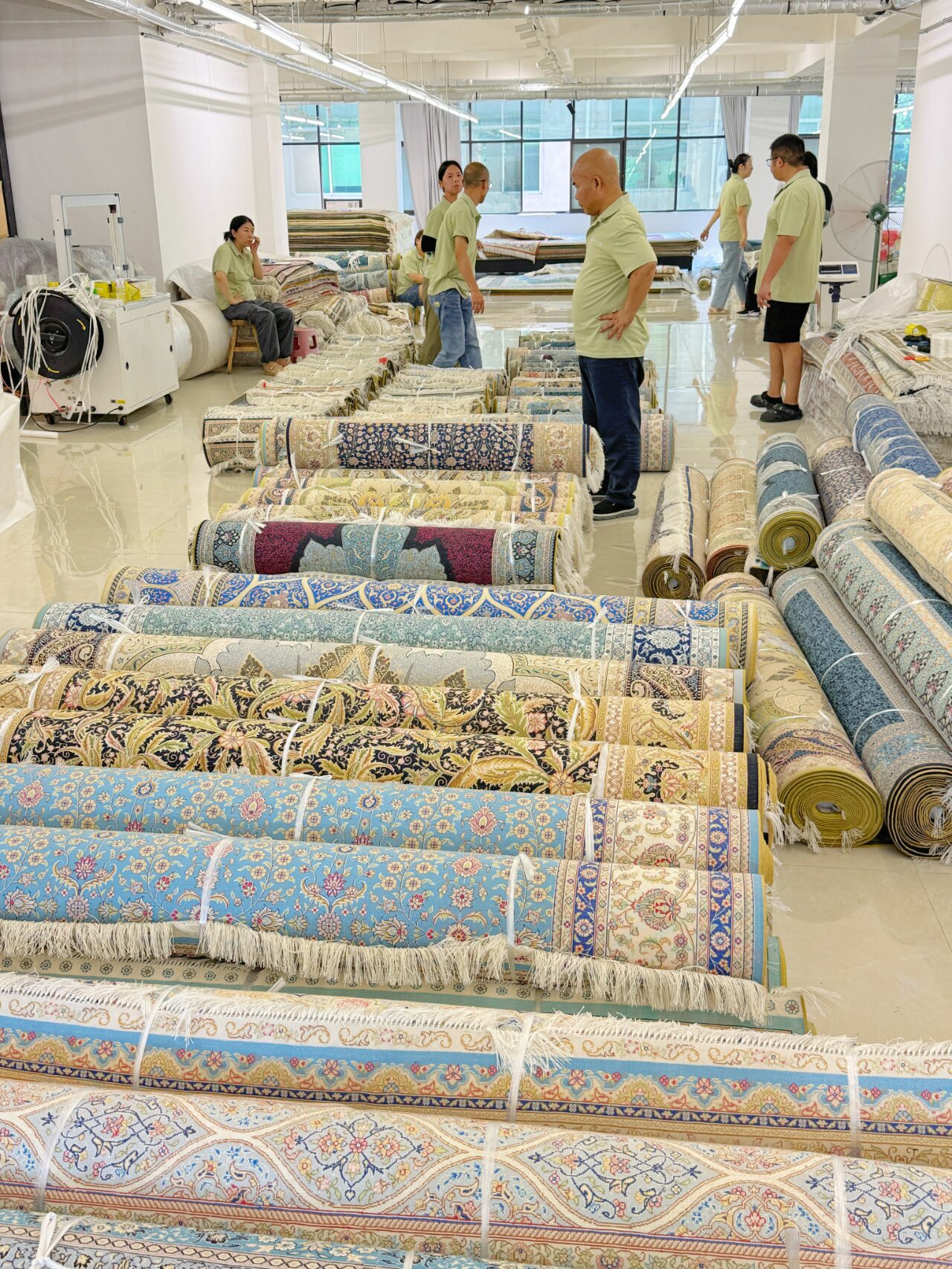
Today, the global carpet market is not short of rugs.
Machine-made rugs, tufted carpets, project carpets, and commercial floor coverings still take up a large part of the demand. Price, delivery time, and production scale still matter.
But at the same time, another kind of market is becoming clearer.
This market does not only ask whether a rug can cover the floor. It looks at material, craftsmanship, design, aesthetics, and long-term value.
The departure of this batch of hand-knotted silk rugs gives us a useful window into the market.
It shows that the international carpet market has not lost demand. Instead, demand is becoming more specific, more selective, and more clearly divided.
1. The Global Carpet Trade Still Has Volume, But the Logic Is Changing
From the perspective of global trade, carpets have not disappeared from the international market.
According to OEC data under HS57, global trade in carpets and textile floor coverings reached about USD 16.4 billion in 2024. Markets such as the United States, Europe, and the Middle East still maintain strong import demand for carpets and textile floor coverings.
China’s customs data also shows that in 2024, China’s exports under Chapter 57, “Carpets and other textile floor coverings,” reached about USD 4.383 billion, up 9.5% year on year.
These figures show that carpets remain a stable category in international home furnishing, project decoration, hospitality, commercial spaces, and residential consumption.
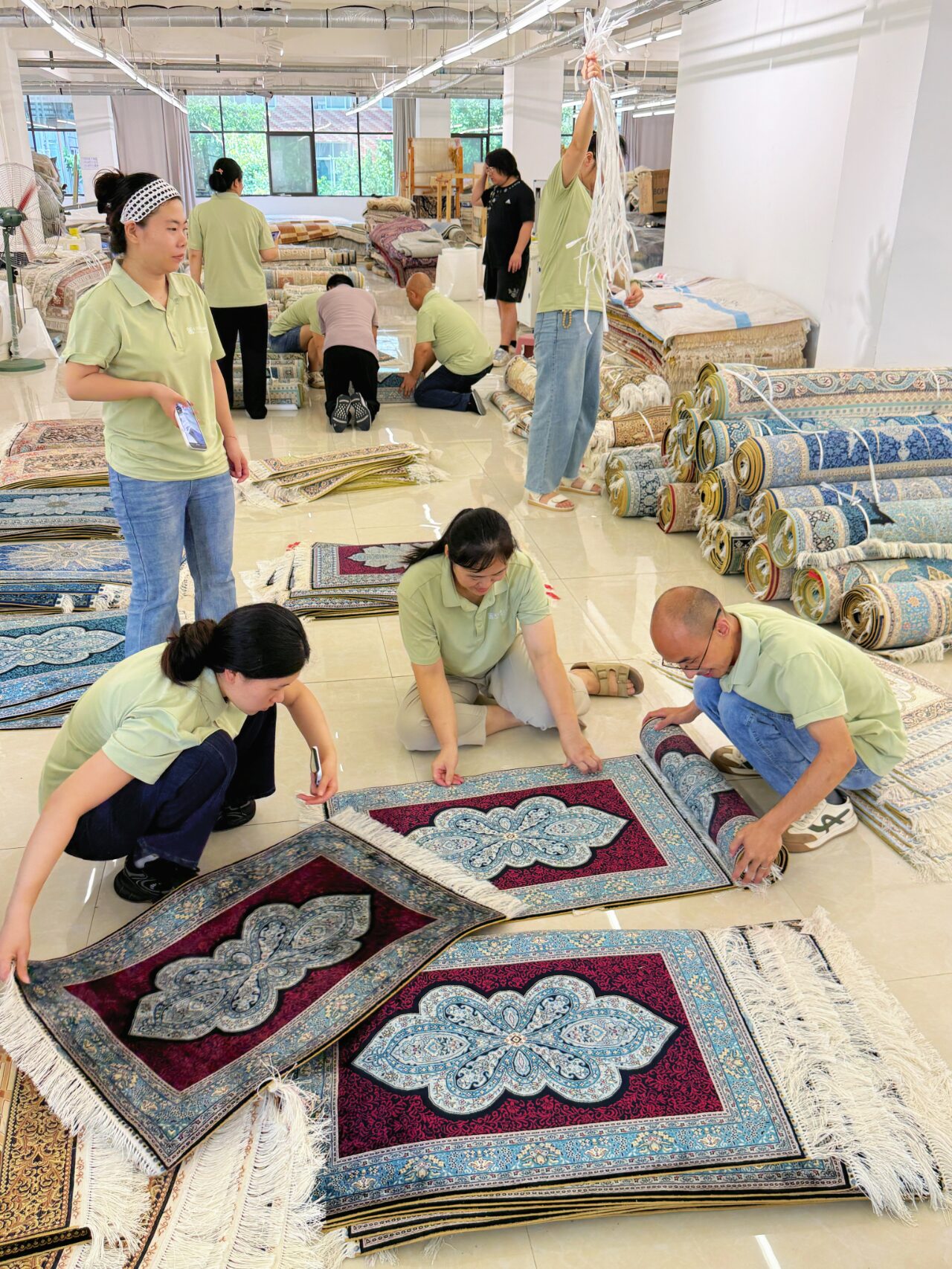
They have not been pushed out of the global circulation system by changing interior styles, new flooring materials, or the popularity of machine-made products.
But the market today can no longer be described as one simple whole.
The word “carpet” may refer to many different things.
Machine-made rugs, tufted carpets, and project carpets are usually about price, area, delivery speed, and replacement efficiency.
Hand-knotted rugs, handwoven rugs, wool rugs, silk rugs, and collectible carpets follow a different set of standards.
Buyers look at whether the material is real, whether the craftsmanship is fine, whether the colors can last visually, and whether the rug can enter a space and still be appreciated after many years.
So when we talk about the international carpet market, we cannot only look at total volume.
The total volume tells us that carpets still have a strong base.
But the more important point is this: different types of carpets are entering different layers of the market.
Mass-market carpets compete on efficiency.
High-end handmade rugs compete on time.
2. China’s Carpet Export Market Is Dividing, and Handmade Rugs Are Taking a Different Path
When we shift our view from global trade to China’s export side, we can also see this change.
According to the 2026 first-quarter report on China’s carpet industry exports, compiled by the Carpet Committee of the China Arts and Crafts Association, China’s carpet export value from January to March 2026 was USD 1.04 billion, down 1.63% from the same period in 2025.
In March alone, exports reached USD 270 million, down 32.03% year on year.
This means China’s carpet export is not moving in a simple straight line of growth. It has entered a more complex adjustment period shaped by global trade fluctuations.
Looking at different regions, the market has already started to split.
The United States remained the largest export destination. In the first quarter, exports to the U.S. reached USD 258 million, accounting for 24.8% of the total, with a slight year-on-year decline of 1.64%.
The European Union, however, became a bright spot. China’s carpet exports to the EU reached USD 136 million in the first quarter, up 15.95% year on year.
The GCC market declined overall, but markets such as Qatar, Kuwait, and Oman still showed growth against the wider trend.
These changes show that China’s carpet exports are not without demand.
Instead, different markets are moving at different rhythms.
Main markets are under pressure.
The EU is growing against the trend.
Some emerging markets are finding growth through project carpets, mid-to-low-end carpets, or regional trade demand.
That is why we cannot only look at total export numbers when discussing Chinese carpets going overseas.
What deserves more attention is this: while large-category exports still maintain scale, high-end handmade rugs that depend on material, craftsmanship, and aesthetic judgment are entering more refined international markets.
Hand-knotted silk rugs are not trying to find every market.
They are trying to find the markets that are still willing to pay for long-term value.
3. Mature Residential Markets: The Shared Demand in the U.S., Canada, Australia, and Singapore
The United States is one of the most important markets to look at when discussing international carpet imports.
It is not only large in import volume. More importantly, its residential spaces, home furnishing consumption, and designer channels are already highly developed.
In the U.S. market, there is strong demand for machine-made rugs, tufted carpets, wall-to-wall carpets, and commercial carpets.
At the same time, there is also demand for high-end handmade rugs in villas, large homes, private reception rooms, studies, and interior design projects.
For products with this level of craftsmanship, the opportunity is not in low-price competition.
If a rug is only meant to cover the floor, machine-made and tufted products are already efficient enough.
But when a rug enters a large living room, a study, a reception area, or a designer-led interior project, the buyer is no longer looking only at price.
They are asking whether the rug can complete the space.
A large room needs a rug to create a center.
Restrained furniture needs material layers.
An open-plan home needs a rug to bring the sofa, coffee table, lighting, and human movement into one visual area.
In this context, a rug is not just a floor covering.
It becomes part of the structure of the space.
Canada, Australia, and Singapore can be understood through a similar logic.
What they share is not necessarily a deep traditional carpet culture. What they do share is mature modern residential space, along with consumers who are willing to pay for living quality, imported home furnishings, and long-term use.
For these markets, a well-chosen hand-knotted silk rug is not simply a traditional symbol.
It is a soft structure that gives a modern home more depth, warmth, and a stronger sense of presence.
4. Aesthetic Judgment Markets: Europe and Japan Care More About What Lasts Visually
If mature residential markets care more about spatial completion, Europe and Japan are closer to what we might call aesthetic judgment markets.
They may not always want the largest size, the strongest color, or the most decorative pattern.
But they often care deeply about design restraint, real materials, finishing details, and long-term visual endurance.
Europe is a clear example.
CBI’s market information on handwoven rugs in Europe points out that there are opportunities in the mid-to-high-end handwoven rug market, but competition is also strong. Suppliers need to create value through design, craftsmanship, sustainability, and storytelling.
This tells us something important.
European buyers do not simply like rugs because they are expensive.
They also do not judge a rug only by how complex or ornate it looks.
They care more about whether a rug has design logic, and whether it can form a relationship with furniture, art, light, and architecture.
In many high-end European homes, a rug is not used to overpower the furniture.
It works with sofas, woodwork, artworks, and natural light to create quiet layers.
It can have presence, but that presence does not always come from loud colors or crowded patterns.
More often, it comes from material, proportion, and color relationships that slowly reveal themselves.
Japan is another kind of refined market.
It is not typically a large-volume export logic. It is more like a market of close looking.
Japanese buyers often pay attention to whether the material is genuine, whether the color is clean, whether the pattern has order, whether the knots on the back are clear, and whether the overall finishing is refined enough.
This kind of market is especially suitable for smaller sizes, lighter and more elegant color palettes, fine patterns, study rugs, entryway rugs, bedside rugs, wall-hanging carpets, and collectible pieces.
The opportunity here is not visual shock.
It is detail.
The smaller the space, the less room there is for roughness.
The closer the viewer is to the rug, the more clearly the foundation of the craftsmanship can be seen.
5. Culture-Based Markets: The Middle East and Turkey Understand the Spatial Meaning of Carpets
The Middle East has another way of understanding carpets.
In Saudi Arabia, the UAE, Qatar, Kuwait, and other countries and regions, carpets are not only used in ordinary homes. They also appear in grand reception rooms, hotel lobbies, religious spaces, high-end commercial interiors, and ceremonial settings.
In these spaces, a carpet is not a small decorative extra.
It participates in the order of the room.
However, the Middle Eastern market is not one single, fixed block.
In the first quarter of 2026, the GCC market declined overall. But Qatar, Kuwait, and Oman still achieved growth against the trend.
Meanwhile, Iraq, Saudi Arabia, and the UAE saw larger declines in March alone.
This shows that the Middle Eastern market has cultural demand, but it is also affected by regional politics, purchasing cycles, and economic fluctuations.
For high-end handmade rugs, the Middle East is still a market worth watching.
The glow of silk, the visual strength of large sizes, fine patterns, and classical elegance all fit many high-end Middle Eastern spaces.
But truly high-end spaces also care about proportion, material, and order.
A rug can have presence, but it cannot simply be filled with patterns.
It needs to hold the space, while also working with light, furniture, and architectural scale.
Turkey is another special example among culture-based markets.
It has a deep carpet tradition and has long been active in the international carpet trade.
People there have used carpets, lived with carpets, traded carpets, and compared carpets for generations. They know how to tell the differences between origins, materials, craftsmanship, and patterns.
That is why this batch of about 20,000 sq ft of hand-knotted silk rugs going to Turkey means more than “shipping overseas.”
It is entering a market that understands carpets, compares carpets, and truly tests the product itself.
The more a market understands carpets, the less it will stop at surface beauty.
It will look deeper, toward craftsmanship, material, and time.
6. The Export Logic Is Changing
When we put these markets together, one trend becomes clear: international carpet demand is becoming more specific.
Mature residential markets need rugs that can enter large homes, reception rooms, and designer projects.
Aesthetic judgment markets need rugs with design restraint, material quality, and refined details.
Culture-based markets need rugs with scale, silk glow, ceremonial presence, and the ability to stand up to real comparison.
For high-end handmade rugs, the logic of export is also changing.
In the past, many discussions about export focused on quantity, price, and production capacity.
Today, if high-end handmade rugs want to go overseas, it is no longer enough to say, “We can make a lot.”
The better question is:
Who is this rug for?
What kind of space does it belong in?
What kind of lifestyle does it speak to?
The same hand-knotted silk rug can play different roles in different markets.
In the United States, it may become the main rug in a large living room.
In Europe, it may become a refined textile piece with craftsmanship and restraint.
In the Middle East, it may become the visual center of a reception room.
In Japan, it may become a small, detailed, collectible rug worth looking at closely.
In Australia, Canada, and Singapore, it may become a soft furnishing choice that adds more layers to a modern home.
Export is not only about sending a carpet out.
It is about placing a rug inside another country’s lifestyle and aesthetic system.
A brand that truly understands the market does not use the same message for every customer.
It understands why different markets need carpets, and what standards they use to decide whether a rug is worth keeping.
7. What Truly Remains Is a Rug With the Value of Time
The international market today is certainly not short of carpets.
Machine-made rugs can be faster.
Tufted carpets can be cheaper.
Project carpets can be more standardized.
They solve practical needs in large-scale spaces and make up the main volume of global carpet trade.
But hand-knotted silk rugs have never been products that win by speed.
Their value comes from slowness.
One warp thread.
One weft thread.
One knot after another.
The pattern is not printed on the surface.
The silk glow is not added later.
It comes from the silk itself, and from the density and patience left behind by weavers who spend long hours at the loom.
Nearly one thousand weavers.
Several months of work.
About 20,000 sq ft of hand-knotted silk rugs.
When these numbers are placed together, they are not meant to create noise.
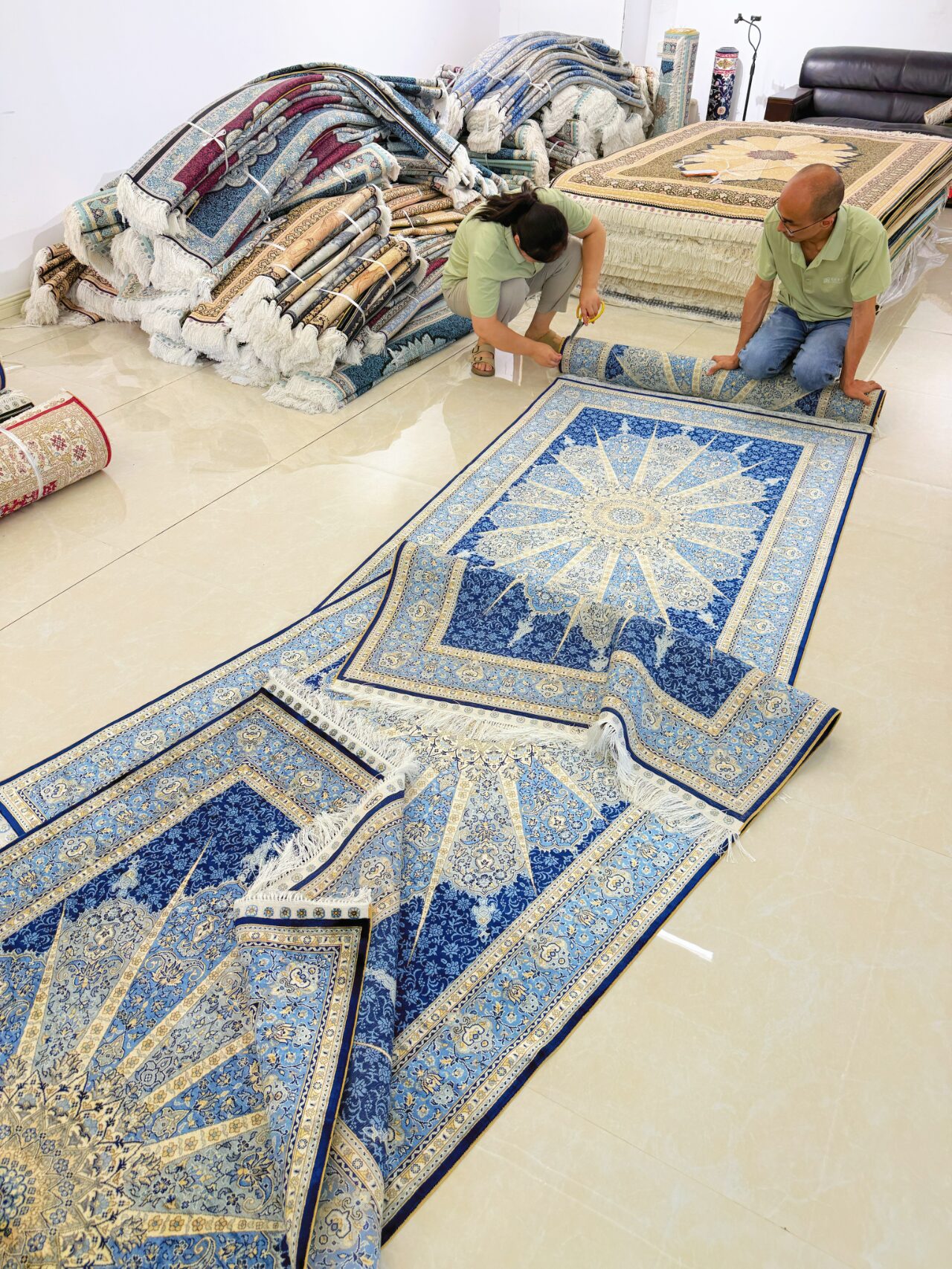
They remind us that a true handmade carpet is not something that can be rushed into existence.
For us, the departure of this batch of rugs is not only an order being delivered.
It is also a reminder.
As the market becomes more segmented, true handmade rugs still need to be woven with time. And they will still be seen by people who understand material, craftsmanship, and the value a rug brings to a space.
A truly handmade rug does not only arrive in a country.
In the end, it arrives in the spaces where people are still willing to pause for time, material, and handwork.